Showing posts with label leadership. Show all posts

Nov 14, 2008

because everyone knows

I can't believe how late it is and I can't sleep. I keep having these dreams... I've been having them all week, and they seem to be the product of some of my worst fears. Last night it was losing my youngest son in a large city and not being able to find him. Tonight it was something that seems incomparable to that, and yet is very important.

Remembering the whole dream is hard, but (tonight/this morning/what time is it?) I remember the last part. For some reason our church was meeting in our old movie theater, even though it was today's era (we now meet in a new building). As best as I can piece together, I'd given the order of service to a couple of our staff guys and left the room to collect my thoughts once service began. That's when things got chaotic... for even in my dreams (apparently) I care about what happens in our services because everyone knows they affect people who are thee to connect with God.

The band was supposed to play a song, and then play some instrumental music while the bandleader prayed. Instead, I heard (from outside the theater) that this wasn't happening - instead, people were spontaneously praying about different things - no microphone, but rather random praying around a room (which included the power talkers who could project and the quiet talkers who said important things, but no one could hear them). As I made my way in, someone was praying that the Republican Party would eventually come back into Presidential power. Even though it was a dream, I was about to lose it... fearing that we'd crossed some line of political ethics that the IRS would feed on and shut us down... because everyone knows you're not supposed to do that.

So I made a hand gesture to one of our staff guys that looked like a keyboard. This was my baseball-esque signal to go back on stage and play some music so I could grab a microphone and steer us back into a God-focused direction vs a GOP one... because everyone knows that a service isn't supposed to be patriotic or in favor of a political party... right?

The only problem was as I was about to do this another person behind the computer started rolling a video on the main screen. There were two... no, three problems with this.

One - it was an unrelated video to anything we were doing. Apparently, it was one of those videos people send in an email and want you to watch, only you're not sure it's a virus so you don't watch them and it sits in your email forever - like that bottle of mystery condiments most refrigerators have in them (you're afraid to use it, but don't want to throw it away because one day you might need it). The video was some odd, YouTube-esque cartoon that mused about nothing in particular, then it ended with some random credits, followed by pure silence while personal pictures of the person who sent the video began being displayed in an automatic slide show of some sort. I kept fearing that a pornographic picture would cap it all off, but thankfully/sadly it was just camera phone style pics of them doing daily life.

The second problem was that the video intended for that moment got washed away in the process of it all. That one brought us deeper into the Scripture we'd be studying that day... somehow I know it did, even though (because it was a dream) I can't tell you what it was. But whenever we use a video in our services it's with intentionality - to either provoke a thought, raise a question, help someone identify with the topic at hand (or vice-versa, help build a bridge into their lives), or make us laugh about something we need to laugh about (laughter is way overrated). We stay away from all the cutesy Christian videos that preach tradition and fear with cheesy solutions that don't practically play out in real life, because everyone knows they have no value... right?

Oh, and the third thing wrong with this moment? Well, I sort of misspoke - the video wasn't being projected onto the movie screen. Rather, it was being projected where the screen should have been. For some reason a large movie screen curtain was sort of covering the whole screen area, and so this lame video was being projected right onto textured, fluffy, foo-foo fabric.

I remember needing to sit down in the dream... to find an aisle somewhere... so I could scream. We were doing an awful thing (I thought and felt and feared), for someone who had come to service that day had to be thinking, "These people are so messed up that they can't even operate A/V equipment properly. Now I have my reason to give up on church and God and heaven and all of that." I'd broken an overly spoken, unspoken rule that my type-AAA church background had tried to drill into my type-B personality - you don't create a bad first impression, because everyone knows people won't come back if you do... right?

Keep in mind, I don't really believe that is always true but I do know that it is important to give your best swing at everything when lives and souls are on the line.

Here's where it gets real interesting, though.

Just at the point in my dream when I'm about to explode in exasperation, I start laughing. Hard... out loud... deliriously. Not because I've lost my mind, but rather the opposite. As I look down at the screen (stadium seating, and all) I see one of our staff guys - our worship leader - jumping up with all of his might to grab high for the string that pulls the curtain open. For some reason, though, the curtain doesn't open to the side or have an automatic mechanism to make it move - instead, it opens up like a window blind might. And so as he jumps up and down trying to pull the cord, this large movie screen curtain keeps going up and down with him... up and down... up and down... while the slide show cavalcade continues, again, in pure silence.

Except for the sound of the curtain going up and down. It even sounds like a cheap window blind, in fact.

The best part was the look on his face. He was actually smiling while he did it, as if somehow in the midst of all of this chaos he realized, "Yeah, we messed this up. But so what? Let's fix it and not worry about what we can't worry about." He got that from me, I think... because I often say that when things go wrong.

Because everyone knows things go wrong a lot when it comes to church life. Whether it's the things that do or don't happen in service that become mental splinters to anyone who cares the phone calls that don't get made when someone is in crisis (leaving them feeling alone), a human community handling Divine things will always fall short of perfection. Watching our worship leader enjoy swinging around one the curtain ropes to try to get them to cooperate was such an amazing symbol of that truth.

As I sank into my stadium seating, fluffy high back theater chair in my dream and watched it all, I felt as if I'd woken up.

And that's when I actually did.

------

This is simply me dumping out my dream over the course of 40 minutes, because I knew there was something in here I needed to pay attention to.

On one hand this can be a parable about what matters and doesn't matter in church world. As I hinted at earlier, I came to Jesus in an environment that valued goals, trackable data, above-the-waterline leadership, and excellence in effort. After all, we're talking about people's eternal destinies and that certainly demands our absolute best. Keep in mind my natural DNA that valued relationships, process, below-the-waterline integrity, and faithfulness in ministry... so I feel I walk around with a decent toolbox that is at God's disposal.

But really, it isn't about church world.

It's about that thought - "because everyone knows." If you've ever thought or said that, you've expected that the people in your life see, understand, and value the things you see, understand, and value just as you do.

Maybe it's how a house is supposed to be cleaned, "because everyone knows" you do a certain way. Or how a meal is to be prepared, "because everyone knows" you cook it at this temperature with these ingredients... and not at that temperature with those ingredients. It might even be how a husband and wife relate to one another intimately, "because everyone knows" what is considered acceptable versus profane in the bedroom.

What is ironic is that when we occasionally do recognize "because everyone knows" that no one knows the same thing, we use it as an excuse to not do the things that we really are supposed to know.

Think about that a moment.

In my dream and in my life, I hope that others see, understand, and value the things I do. I believe that "lost" and "found" people matter to God and that they are finicky people... so if by chance they are willing to let someone into their lives to share insights and challenges from the Lord that those opportunities shouldn't be treated lightly. Such "challengers" or "teachers" or "leaders" or "fellow believers" need to call them when they will receive phone calls from us, study together when they will study with us, empower them when they will be empowered by us, and rebuke them when they will receive rebuking from us (you know, we all need a little rebuking from time to time - even though we hate it when it happens - as long as it's done in pure love).

So when I feel like those things that seem so "obvious" to me aren't as valued in the people around me, I start to pace around in my head and feel my heart develop a chaotic rhythm. "Don't they get it?" I want to scream? Only I don't scream, because everyone knows that if you scream you run the risk of making people angry, and you don't want to get people angry because everyone knows angry people shut down lines of communication and you won't be able to talk with them about the stuff that matters most.

Hopefully by now the application and analogy is clear to you. And if for some reason it isn't, just pay attention to those moments when you also want to scream "Grow up!" and "Don't you people get it!" and "Come on already, stop living so selfishly and see the BIG PICTURE here!" Is it possible that you are holding people to your standards instead of their own?

And if it is a standard they should hold to (or say that they do, but they don't seem to live it out) is it possible for you to be the smiling fool on the curtain strings, helping them glimpse at how there is a better way than just sitting in front of the closed curtain that they've chosen to be silent spectators of?

"With a loud cry, Jesus breathed his last. The curtain of the temple was torn in two from top to bottom." (Matthew 15:37-38)

"...whenever anyone turns to the Lord, the veil is taken away." (2 Corinthians 3:16)


Because everyone knows what that means, it's time for me to try to go back to bed.

Apr 13, 2008

a perfect search for the imperfect leader

In these days of political debates and "candidating to be a candidate," I am greatly puzzled at our snarky attitudes about anyone in power.

Anyone.

I am too young to remember anything different, for it seems like from the time I've been able to turn on the TV there have been critics about anything and anyone in "Washington D.C." - which sort of sets the stage for general cynicism all around. (Maybe that's why The Daily Show and Colbert Report have had appeal to me over the years.)

Yet I hear that in my parent's and grandparent's generations there was an era where those in office received respect from those they were entrusted to lead. Can you imagine that? Instead of distrusting our political leadership, we put all our marbles in that basket.

(Yes... I'm aware I said that phrase wrong. Think about it.)

Somewhere around Nixon a clear shift occurred, but even before then there were rumors that JFK had a thing for Marilyn Monroe.

Of course, that was unfathomable for many.

And yet...
  • It led toward the country not being so sure Johnson was being up front about Vietnam....

  • not to mention Nixon after he resigned because of Watergate...

  • and Ford went under fire for pardoning him...

  • only to find that Jimmy Carter was the target during the whole hostage crisis that no one was sure he handled right...

  • which Ronald Reagan took car, but certainly stirred up some more doubt of Presidential leadership when rapid inflation happened (not to mention Iran Contra)...

  • and then George Bush was the "new hope" (please note subliminal, double-edged "Star Wars" reference), but after the Persian Gulf we all wondered if the next World War was about to happen...

  • but it didn't, because as Clinton entered the scene we had great confidence in his charisma... and he did speak well... even during his impeachment trials...
  • so when George Bush won (did he?) and the country was divided (is it still?), we sprung back for a brief moment... about 911 minutes... only to run back quickly in opposite directions.
I wonder if we've just been ready to criticize George Bush from the get-go because we've trained ourselves to do so.

And I wonder if the next President even has the chance to be the hero every voter hopes he/she will be.

(Yes, I included "she" - doggone it.)

I also wonder sometimes if the real issue with our critique of the Presidents has only increased as more and more news outlets have given us more access to them. Some of the "great leaders" like Washington and Lincoln probably had a whole lot more faults than we know about because CNN wasn't around (even though Larry King may have been).

In my opinion, we will never truly have the perfect president we all try to vote for every year. We know this, of course, and yet perhaps it's the illusion of our vote actually making this happen that pacifies us.

Which, again, causes us to doubt anyone in positional authority. Maybe this is why...
  • Water cooler gossip easily happens about the boss.
  • People wonder "what's really going on" with televangelists.
  • When someone dies, families fight with the executor of the will (especially if it's a family member).
  • Church congregations might second-guess goals set by committees or staff teams until they gain momentum and are "safe" to get behind.
  • Parents in the athletic stands yell at the ref/ump/coach.
  • No one wants to buy a used car from a used car lot.
  • Even news stations are views as too slanty one way or another.
Perhaps all of this hints at our need and unconscious wanting for a Savior who is, in fact, quite perfect.

After all, there was a time when kings and presidents didn't exist... and God did.

I hear that it was described from His vantage point as "very good."

Feb 25, 2008

leadership leanings

A friend of mine sent me a questionairre at the end of last year that I had fun filling out. No, this isn't one of those snarky chain-email surveys. Rather, it is about the way one leads in a ministry environment. The fun part was articulating things that often come naturally, so please allow me to share. I'd welcome your feedback.

At your place of employment tell me what your role is and how many employees or volunteers that you have under your supervision?

  • Lead pastor. I serve six paid staff and through them the many volunteers that make up our church.


What is your leadership structure for your ministry?

  • God-led, pastoral-guided, church-empowered.

List three things you want to accomplish the first day in the office?

  • Establish a prayer base, connect with leaders, realize and maximize my sphere of influence to reach out to the lost.

Outline your process on how you recruit leaders to be a part of your team?

  • I don't. Instead, I sit down with people and listen to what's happening in their hearts. Then I ask them how I can serve them in letting that vision become a reality. On rare occasions I will ask people to do something that needs to be done, but only after I've first heard their heart to know if it's a match.

What are the forms of communication you utilize with your team?

  • Weekly staff meeting, daily emails to staff, weekly email to the church, encouraging text messaging to subscribers, cell phone calls throughout the day.

What events do you do with your team of leaders?

  • Lots of missional activities that bless the community, whether or not it tracks back to us. We also try to have our families get together every few months for fun.

Do you have a detailed plan on how you develop your leaders?

  • Yes. This hasn't been in place in past years, and so this is the year I'm developing the leaders under my care and teaching them how to develop those under them. I believe next year will take it to the next level, and we've already done some formal leadership connections to help with this. Essentially, I use Ken Blanchard's "Situational Leadership" model as a guideline, but ultimately follow the Holy Spirit.

In your eyes what is the perfect leader on your team? Who would you say models a great leader?

  • A perfect leader is someone who is trying to bring out the best in the team as a whole. We're not looking for a staff of track and field types where we applaud each other's events from the stands. Rather, we're more like a baseball team and do our best to work together for the same things. Every person brings something special to this, from the logic-minded number cruncher to the wiseguy worship leader.

Outline an agenda for a leaders meeting?

  • Chit-chat before meeting (if this isn't happening, something is wrong). Then, start meeting off with something fun (from an icebreaker to a stand-up comic clip on YouTube). After this we go through our agenda in a bullet format, then begin to dig into it one step at a time. We always start with review of where we're at, then talk about present issues to better determine where we're going, and then let where we're going better examine present issues.

What expectations do you have for your ministry leaders?

  • In order, love for God, love for spouse, love for family, love for the church. This involves being a self-starter, developing relationships with the lost/saved/leaders, reconcicling with anyone they have issues with, and becoming a growing expert in their area. Authenticity, loyalty, and a sense of humor a must.

Do you have a leadership contract that you make your leaders sign? Please include a copy of your leadership contract.

  • Not yet. We do revisit job descriptions yearly, though.

Is leadership evaluation done on an ongoing basis or at schedule intervals?

  • I meet with my staff collectively on a weekly basis, then also meet with them 2x a month one-on-one to develop them personally and professionally. Every three months we set goals and evaluate previous ones.

How do you keep leaders accountable and hold them to their commitment they made to your ministry?

  • I hang out with them... relationships inspire loyalty.

If you could give me three points of wisdom that I need to know about building a team, what would that advice be?

  • Assist others, then assist others, then assist others. In doing so the pressure to be a visionary leader will be trumped by the authenticity of being a leader of visions.

What are three pitfalls that you have come across on your leadership journey?

  • Insecure people have loud voices, past leaders you've replaced have credibility you don't, and without a strict Sabbath you will die.

Feb 1, 2007

transitions

Tonight my wife asked me a really good question.

Keep in mind that I was in the midst of typing out an email to one of the staff members I've privileged to serve with. Her query couldn't have been better timed.

"Do you believe you're doing what you're doing?"

I smiled... I knew what she meant.

"No... and I hope I never do. You know what I mean? The second I do I think I will be in trouble."
Right now I am walking in the humility of having a new, front row seat to what God is up to in our area. Granted, that's a faulty metaphor because my role isn't to sit but to kneel; and not just to kneel, but to run; and not just to run, but to be still; and not just to be still, but to be.

Or in less poetic terms, I was at a seminar this past weekend and someone asked, "So you're the new lead pastor at Connection Church in Medina?"

I nodded and smiled, saying, "Yeah... somehow."

It's funny because as much as that sounds like something in itself I should be "established" about I find I'm more in awe of the journey that brought me here and the one I am currently engaged in. The second I find myself losing touch with how amazing it is to communicate Christ, champion His redemptive cause through a local church, move toward lost people so that they move toward God, deepen existing Christians into new levels of connection, and unleash others into their own soul-stirred up ministries... wow, I think I will be in real trouble.

We tend to live for the benchmarks, but I'm finding life is best lived in and revealed in the transitions.

Here are a few of mine.
  • A steady church community to be a part of and invest into... people who have been amazingly welcoming, giving a good balance of invitation and space. My family has intentionally met that with gratefulness that we're not "the pastor, the pastor's wife, and the pastor's kids" but can truly be "Tony," "Katie," "Joshua," and "Daniel."

  • I get to serve with a group of five people who are not only amazing at what they do but have quickly become good friends whom I get to do life with and serve.

  • Our neighborhood is a mix of the relational cul-de-sac we live in and the apartments behind our backyard... we've already gotten to know several of the households, been blessed by one couple coming to visit our services, found out another are Christians who lead worship in their church gatherings, and see continued evidence of many, many boys (who all seem to be about our boys' ages) that all live down the street.

  • We have a house to live in... something we can put holes into, repaint as we'd like, play tag in, and so forth.

  • I am discovering the ways God has groomed me in the past two years and given me several tools to guide things forward here into the next chapter. For instance, I've written two books that train staff members in a church, a whole school year worth of material to train leaders who want to invest into students, a 30 day devotional for teens... and find myself leading a staff, looking for someone to invest into teenagers, and wanting to give something to the teens we have. Nice timing, God.

  • The blessing of building into our lives as a family a rhythm of work and restoration.
What's interesting is that many of these things may still be the in a year. I wonder, though, if I will still live in the excitement of these truths then as much as I do now. Will I be as giddy as I was after my first week "on the job" where after my first sermon I turned to my wife and tapped her leg as I said, "GUESS WHAT? I GET TO DO THIS ALL AGAIN THIS NEXT WEEK!"

Why not?

Whenever we make a switch from one thing to the next we are often in what is called the "Honeymoon Stage." Personally, I think this short-changes the concept of what a honeymoon is in marital circles - as if there is a period where you have thick feelings for someone and everything is awesome... as if you couldn't work to maintain that over the long haul.

That's bunk... I'm over 12 years into my marriage and am madly in love with my wife.

So could I be the kind of guy who is still in love with God and appreciative of all these blessings in a year? Five years? Ten years?

Again, we tend to live for the benchmarks, but I'm finding life is best lived in and revealed in the transitions.

I followed God who challenged me to move here... whether in a year we have 1000 more people or close up the doors doesn't matter because my role is to be faithful and his role is to be God. I signed up for a revolution... not a spiritual business. My goal as a Christ-follower, husband, dad, and pastor isn't self-preservation but of Kingdom living and revealing... and however God chooses to use my energy bursts in that direction is His call.

I deserve none of this... none. I know many people who are happy for me and see how this "makes sense" because of "all I've been through." Thank you... honestly, thank you. You may be right, and I'm grateful you would think that God would bless me somehow after some of the trials we've been through.

But, um... I don't see it that way.

Entitlement will rob you of your joy, and so I'd rather remember I'm entitled to nothing and celebrate whatever God gives me with giddy and geeky laughter. I don't have a problem spiking the football, mind you, but I don't ever want to forget the coaching, blocking, passing, and carrying my Savior has done in my life to get me in the endzone. If I do a little dance - which I have, by the way - it's only because I keep looking around and am in awe of how freaking awesome God is.

And speaking of gifts, can I just celebrate my wife for a moment?

They say that Ginger Rodgers did everything Fred Astaire did... yet what most people miss is that she did it backwards and in heels. Kind of reminds me of my wife - as we have transitioned from our last chapter to our new chapter, I have been unbelievably blessed by her and the things that come out of her heart. She is truly a "helper" to me in the way that I think God intended, and hopefully I am to her the same. Everything I'm doing is better because of her thinking and sharpening... I mean, I'm actually amazed sometimes when she talks - I feel like everything just went up a notch.

So in summary...

If/when you ask me how the transition has been, would you please ask me the same question in a year?

And then the year after that?

And then the year after that?

And so on...

and so on...

and so on...


At that time the disciples came to Jesus and asked, "Who is the greatest in the kingdom of heaven?"


He called a little child and had him stand among them. And he said: "I tell you the truth, unless you change and become like little children, you will never enter the kingdom of heaven. Therefore, whoever humbles himself like this child is the greatest in the kingdom of heaven. (Matthew 18:1-4)

Aug 29, 2006

name tags

I glanced at my dresser the other day and saw a bunch of my name tags. One was a driver's license, another a press pass I got for the WCA Leadership Summit, and still another a tag I received at a regional gathering (which ironically had me listed at a church I'm no longer at). Then there was a pocket certificate of ordination (just in case I ever have to prove I'm ordained... you know, like when I'm buying stamps) and a bunch of pictures from my wallet that help me think about the family I am a dad and husband in.

Name tags. Things that in some way are to help identify who we are, be it to ourselves or to other people. Little mementos that attempt to label us for a purpose.

"Labeling... for a purpose."

It's like when someone in an interview or assessment asks you the question, “So what are your strengths and weaknesses?” It’s the famous lame question that someone came up with on some standardized test, then wrote a book about it, causing it to be quoted at lectures that companies would require their managers to sit through, creating the goofy process of evaluation that we know today.

(I don’t like using the word “hate,” so please keep in mind what I’m about to say. )

I hate that question.
Interviewer: “So what are your strengths and weaknesses?”

Interviewee: (thinking: “I need to pick the strengths that will help me get this job and think of some way to reword a weakness into a strength… let’s see…”) Obviously, my greatest strength is that I’m a people person. My vast background in your department’s specialty, though, is probably what you’re most interested in. As for weaknesses, I’d have to say that I’m a hard worker and may tend to put in extra time in order to get something done. Sometimes that interferes with my personal life, but I think I manage it well.”

I wonder if this question isn't anything more than a lazy way of someone trying to find out one of two things (if not both):

  • Does this person have a healthy handle on himself/herself?
  • How can I avoid doing a bunch of reference checks?

Okay, maybe I’m a bit cynical because I don’t think you can ever come to a clean conclusion to that question. When someone asks it of you it is usually in a situation that you are trying to prove something, be it to gain a job, pass a psych test, or maybe even become a church planter. Even when we try to be honest and objective we have to defer to what people have told us about ourselves.

Which merits the question…

Do you accept the name tags people attempt to place upon you?

Here are some of mine.

“You probably don’t want to hear this, but you should write for a living.”

“You know, you’re really a great writer. You should do that as a job. Not that you’re not a great speaker, but I love how you write.”

“Have you ever considered writing? The way you create patterns of thought helps a lot of people see life better.”

Apparently, I should be a writer.

“Wow! That’s was one of the most amazing messages I’ve ever heard. You really are a gifted speaker!”

“You are an amazing communicator, Tony. In our denomination you are definitely one of the top 50 speakers. If there was a church of 5,000 looking for a teaching pastor you would be able to jump in and hit the ground running.”

“Yet again you hit it out the ballpark… as usual. Not that you’ve ever given a bad message.”

Apparently, I should be a speaker.

“When you led our student ministry you were one of the main reasons why our son and daughter loved church. You’re a thinker, and you helped our kids to think about things and take stuff home with them instead of just making it about church attendance.”

“One of the things I love about the way you approach youth ministry is that everything is on purpose. Even the silly games or object lessons that seem meaningless at first somehow take on this spiritual application by the end of the night. You are the king of the curveball.”

“You really love students, don’t you? I can tell. It leaks out of you... and teenagers are looking for that kind of authentic love.”

Apparently, I should be a youth worker.

“Those videos Tony used to make really helped the teaching team to get its message across.”

“I’ve heard so many people say that there’s just something about when Tony leads worship… he is just able to take us into God’s presence.”

“Tony is obviously a gifted writer and producer… if he could find a place to use these gifts to the fullest his effectiveness would increase.”

Apparently, I should be a creative arts pastor.

“You lead by getting to know people first and gaining authority out of those relationships which is one of the reasons why people who lead the other way – demanding loyalty first – drive you crazy. It’s also why your followers will follow you and not just your position.”

“Can I just say something? Thanks for journeying with me. I really love your mentoring. You always seemed to know just the right thing to say when I was in high school and I love being able to just journey with you even after the fact.”

“You have a way about leading people that inspires them. I love that what is most important to you is that you live out what you are hoping others will do. The way you model Christ causes others to want to follow him.”

Apparently, I should be mentoring/shepherding people.

“What I find amazing is that the structures you have come up with in your ministry in order to follow the big picture have been adopted by the whole church.”

“Tony has leadership skills… he does see what should be done to get a project finished.”

“Not too many people know how to lead without having to be in the top leader’s chair. You have a way about you in the way you ask questions and offer thoughts that help guide even those above you toward healthier conclusions. I appreciate the manner in which you participate in meetings and discussions critical to the church. It allows you to lead in a very humble way that breaks through defenses.”

Apparently, I should be an organizational leader.


But…

What about when the the name tags people try to put on you aren't so favorable?

“That was a nice article you wrote. It was a little ‘feely,’ though. Not quite so much mush next time.”

“I’m not sure if you really caught the scope of this project. I think we’re going to have to get together to define rewriting it.”

“That last blog of yours seemed a bit out of your character.”

Apparently, I shouldn’t be a writer.

“When you started talking about the cinnamon rolls in that one message I got completely lost. In fact, a bunch of those messages last fall made me wonder a bit.”

“I’m not sure if you truly understand the mind of an unchurched person. Any speaking you do may be in danger of not connecting.”

“I’m a visitor here today… I couldn’t have been more offended by what you shared and will not be returning to this church again.”

Apparently, I shouldn’t be a speaker.

“If you want to have a more successful youth group then you need to be (choose one: visiting the campus more, having more events, mentoring more, counseling more, meeting more families, bringing back more kids who left, finding more kids who have never come, advertising more, recruiting more, doing more yourself, delegating more out, etc.).”

“I heard what happened this past week at practice was chaos and it cannot be allowed on Sunday at your youth service. I’ve decided we’re canceling the whole thing.”

“You allowed the guys to do WHAT in the bathroom on your mission trip?”

Apparently, I shouldn’t be a youth worker.

“That last video you made is not at all what I asked for. I’m pretty angry that you went in a different direction.”

“You really need to be a better musician if you want to lead a band more effectively.”

“Excellence is a strength, but it can also be a weakness. Because Tony is so gifted he could lean into that instead of allowing others to join in on the fun.”

Apparently, I shouldn’t be a creative arts pastor.

“If you keep trying to live such a holy lifestyle you are going to alienate other people who think they can’t do it. You’ll end up seeming unapproachable.”

“A true shepherd is hardly ever in the office. You need to spend more time visiting people and calling on them at home/work/school/hospital/county fairs.”

“You’re not really in the office much and it can seem to people in the church that you’re not really doing your job. You should spend more time in the office making phone calls so that people can see your car out front… it inspires them to see you working hard because then they know that what they’re paying you is being put to good use.”

Apparently, I shouldn’t be mentoring/shepherding people.

“You really need to cut (so-and-so) out of our ministry team. It’s a bad call to have him/her serving with you and is going to bleed your leadership.”

“I know some people who don’t want to work with you because they don’t like how you lead.”

“Tony needs to learn more how to deal with leaders that are around him… dealing with those who cause problems or ‘waves’ within his ministry.”

Apparently, I shouldn’t be an organizational leader.

For the record, thanks for the compliments… if you’ve ever given me one. Likewise, I appreciate your candor in giving me constructive feedback on where I need to grow.

Psychologically speaking, we need to label people so that our brains have a reference point when we talk to them. We look and so-and-so and think, "So-and-so is named Bob, he likes U2 (except for the Rattle & Hum movie), enjoys reuben sandwiches, and can't stand marinara sauce on pasta." These name tags are intended to give us a thin-slice reference point to get to know someone better.

The problem becomes when we close up those name tags instead of keeping them open-ended.

Let’s face it – people change. You are not the same person you were ten years ago, three months ago, or five minutes ago. We are continually doing our best to keep moving forward, be it in a personal or professional way. We hope someone will see our progress (perhaps even ourselves), yet we are just fine and content labeling everyone else around us in ways that may be true for but one second only to be outdated in the next.

Then again, we can’t help it... can we? It’s a self-defense mechanism because our brains need to come to conclusions about our past and present in order to allow us the ability to have any forward thinking. We unconsciously feel the need to look at Sally and remember that she’s “gay” and “graduated from Michigan State” and “has brown hair” and “likes to drive with the windows down” and “doesn’t like it when people use the word ‘DUH’ because it demeans others.” Then we start to add additional layers of conclusions like, “She’s probably gay because of something that happened to her as a kid” and “I’ll bet she doesn’t like Christians.”

I so desperately crave for people to know how I am different today… how I’m not the person I once was but really am growing. I don’t know why I crave this, but I do. Maybe because I want them to see that Jesus is alive and can actually turn people around… maybe they’ll be inspired to do the same.

Or maybe it’s something deeper and selfish and all about me.

Honestly, I don’t know.

But I do know that any name tag – good or bad – is limited, dated, and simultaneously true and false. Maybe that's why I don't like wearing them at conferences, not to mention often buck at being labeled an "ENTP" or "INQJ" (or whatever other letters someone's come up with to sum me up).

So here’s my new approach – when someone asks what my strengths and weaknesses are, I ask, “In what context?” and “With whom am I with?” and “What are you really asking me?”

After all, when I am strong, I am weak. And when I am weak, I am strong.

Or something like that… whatever short summation I can tag myself with in order to get me through the day.

Or something like that.

He replied, "Why do you ask my name? It is beyond understanding. (Judges 13:18)

Aug 13, 2006

why bill hybels makes me mad

Today I got my first "perk" of being a mild-mannered (freelance) reporter for a great metropolitan newspaper... I got to get into the Willow Creek Leadership Summit for free.

Yeah, baby.

I know many of you are nodding your head whereas others are asking, "What is that exactly?" Picture some of the more noted Christian leaders in our world gathering together to speak candidly about leadership issues that have impact locally and globally. The list this year included everyone from pastors and consultants to Bono (yes... Bono from U2).

Traditionally, Bill Hybels (senior pastor of Willow Creek Community Church) opens the summit with a session and closes it all out the final day. True to form, he tends to hit it out of the park in helping people of church or marketplace backgrounds to keep the main thing the main thing.


Bill's final message today was on clarity... something I've been needing in my life for about the past two years. If you're just jumping in I have been on a pilgrimage with my family to uncover what God's big picture plan is for us in the next few years.

We're still waiting.

Hybels had some good thoughts for about ten minutes or so on the power of clarity. Using the metaphor of a trumpet, he spoke about how a leader's responsibility is to keep things clear for the people instead of blowing all over the place with no clear direction. To leave your people guessing is pastoral malpractice, so to speak.

Keep in mind... I'm still waiting on God.

Then Hybels shared how he had felt the Lord lay on his heart to go in a different direction for this message than originally planned. This wasn't as spontaneous as it sounds, because I get the feeling that this didn't just happen today but perhaps a few days ago... who knows, maybe even a month. Honestly, the guy plans in advance. I know... I used to clean his office. That's another story, though.

Keep in mind... I'm still waiting on God.

So then Bill launched into a telling of the story of redemption. Starting in Genesis 1 and working his way to the very end of the Bible, he hit some key points about how Jesus Christ has given up his life to atone for our sins and substitute himself in our place. That is, should we receive him. All good stuff, but not what I was hoping for.

Keep in mind... I'm still waiting on God.

I started to get mad at Bill Hybels. I mean, who is this guy to spend so much energy on something so elementary when we were all hoping for some killer insight on how to hear from God or share things in a very clear way to our people? I know he's the big man and all, but I just found myself wanting to check out.

Keep in mind... I'm still waiting on God.

Then again, I've learned enough about God and myself to not discount such moments. So instead of leaving the room physically or mentally, I fought to stay in it.

Hybels spoke about what was about to happen next... that "real stories" would be represented in some element we were about to see.

"Baptism video," I quickly concluded and wrote off.

Wrong.

Set to David Crowder's arrangement of "Thank You For Hearing Me," people began to file up to the center of the stage from the back, each holding a poster board. On the first side the poster board showed trials, challenges, and hurdles they've faced in their lives (i.e. addictions, fears, selfishness, etc). Then they'd stop in the center of the stage and flip over their card as a way to illustrate breakthrough moments with God where his hand in their lives became clear. On the other side words were written to illustrate the redemption, victories, and healing He had provided (i.e. freedom, courage, passion for others, etc).

One of my favorites said, "40 years of playing church." The other side said, "10 years of being the church."

I started to break. I mean it... I couldn't keep it in and felt myself just weeping out loud, unembarassed to confess that I just love the Church and the unique way it manifests itself in the local church. Seeing these stories just wrecked me... and it was just what I needed.

That said, I think I even cursed a bit... perhaps at Hybels or perhaps at God. He makes me mad... with his passion for people and the things that really matter. Just when I thought I'd gotten to a place where I could go work some secular job (and leave behind professional ministry) I realized I am still head over heels crazy for the Lord and what he's doing in the world.

One day all this stuff will be peeled back and things will be clear. In the meantime, though, I need reminders and glimpses of what really matters and how the Holy Spirit is filling in the cracks of peoples' lives so that he might bring healing from the inside out.

Keep in mind... I'm still waiting on God.

But in the meantime, I know that it doesn't matter what tomorrow looks like.

Today I have people in front of me that need to be loved and brought to a fresh understanding of what reallty matters.

That includes the face I see in the mirror, by the way.
"Let me hear joy and gladness; let the bones you have crushed rejoice." (Psalm 51:8)

Dec 18, 2005

gladwell (part 4)

A book I really enjoyed digesting this fall was Gladwell's Blink: The Power Of Thinking Without Thinking.

After two years of research, Malcolm has come up with a thesis about the first couple of seconds that we use when making a decision or an evaluation. His theory is that quick decisions based on first impressions often have more depth to them that we give credit to, especially when it is an area of expertise for us. In short, Gladwell proposes that lengthy analysis is often unnecessary and sometimes less information is better than more (although on. occasion people can make tragically detrimental decisions in this manner).

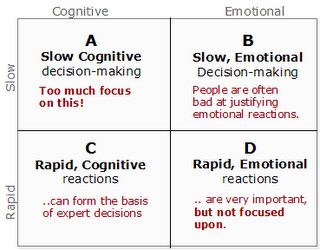
This process of rapid cognition is called “thin-slicing” and involves the action of homing in on a few silent details – the things that leave us with a strong impression even if we can’t articulate why. This ability is instinctive on the level that we do it naturally to mentally survive, yet it is also a talent we can strengthen through self-analysis. Here's a chart and quick description from another blogger.

Blink Chart
  • A: Slow, Cognitive: Human decision making is mostly understood in terms of this slow, deliberate model of decision making.
  • B: Slow, Emotional: When people think too much about their emotional reactions, they might change their minds. Gladwell cites an experiment asking people to choose painting with & without justification. Second group (that had to justify their emotional reactions) liked their paintings much less 6 months later.
  • C: Rapid, Cognitive: Rapid cognitive reactions often form the basis of expert decision making. For example an expert, who can immediately judge if a painting is a fake or not, is making a rapid, cognitive judgement.
  • D: Rapid, Emotional: This cell is the crux of Gladwells' argument. Rapid, emotional decisions happen far more often than it is realized. People make up their minds to like/dislike something instanthly (for example, whether to trust someone or not) seemlessly synthsizing information from current situation and past experience and learning. Such decisions can be indicative of our true thoughts and feelings, but can also be problematic. For example, stereotyping a race, or group falls into the catgeory of such decisions.

Gladwell shares the story of Abbie Conant, a trombonist who auditioned for the (then) all-male Munich Philharmonic in 1980. A member of the selection committee was related to one of the applicants, so to ensure the appearance of impartiality, a screen was erected to conceal the musicians. The philharmonic’s musical director was floored by one performance, but beside himself to then discover that "Herr Conant was actually Frau Conant." Without the visual cues usually provided by live auditions, the musical director judged only with his ears and selected a woman for the first time in the orchestra’s history. "Auditions are about snap judgments," he said. "I’m arguing that this kind of thinking is not marginal. This kind of thinking is fundamental to the way we live our lives."

Gladwell summarizing thin-slicing this way:

“Thin-slicing is not an exotic gift. It is a central part of what it means to be human. We thin-slice whenever we meet a new person or have to make sense of something quickly or encounter a novel situation. We thin-slice because we have to, and we come to rely on that ability because there are lots of hidden fists out there, lots of situations where careful attention to the details of a very thin-slice, even for no more than a second or two, can tell is an awful lot.” (p.43-44)
The dark side, though, occurs when our own priming of prejudices, wishful thinking, and personal psychological baggage get in the way of reading the signals correctly. Gladwell also discussed the Amadou Diallo case, where four New York police officers shot 41 bullets into an unarmed young black man. In that situation, the officers’ snap judgments - "a black man standing alone late at night acting suspiciously must be a criminal" - added up to bad decision-making that resulted in death. "For the most part we are bad at recognizing biases that creep into our thinking, and we’re bad about taking steps to remedy those biases."

This can happen in any workplace from any boss, since the evaluation of staffing, senior leadership, and organizational progress is an almost daily part of the job. Often our own history, fears, and filtered perceptions of others can cause us to come to inappropriate conclusions. In contemporary ministry, this is also key insight for Christian leaders, or as Jesus put it...

How can you say to your brother, 'Brother, let me take the speck out of your eye,' when you yourself fail to see the plank in your own eye? You hypocrite, first take the plank out of your eye, and then you will see clearly to remove the speck from your brother's eye. (Luke 6:42)

I find it interesting in Scripture that this parallels on a human level the spiritual gift of discernment. Is it possible that those who find this "gift" on a spiritual gift test as a high score are just really good at "thin slicing?" I don't mean to discredit the whole testing process of spiritual gifts, but honestly... can a multiple choice, fill-in-the-blank quiz really tell you the complexities of how God has wired you up?

Maybe.

Maybe not.

Perhaps that's another post. In any event, I bring this up in light of the things that we see in life and the decisions we make based on feelings and impressions. What strikes me is how when the prophet Samuel went to look for the king that would replace Saul (who had lost his way), he figured it would be the oldest and the wisest of Jesse's sons. And yet this "thin-slicing" Samuel did was off base. Check it out:
The LORD said to Samuel, "How long will you mourn for Saul, since I have rejected him as king over Israel? Fill your horn with oil and be on your way; I am sending you to Jesse of Bethlehem. I have chosen one of his sons to be king."

But Samuel said, "How can I go? Saul will hear about it and kill me."

The LORD said, "Take a heifer with you and say, 'I have come to sacrifice to the LORD.' Invite Jesse to the sacrifice, and I will show you what to do. You are to anoint for me the one I indicate."

Samuel did what the LORD said. When he arrived at Bethlehem, the elders of the town trembled when they met him. They asked, "Do you come in peace?"

Samuel replied, "Yes, in peace; I have come to sacrifice to the LORD. Consecrate yourselves and come to the sacrifice with me." Then he consecrated Jesse and his sons and invited them to the sacrifice. When they arrived, Samuel saw Eliab and thought, "Surely the LORD's anointed stands here before the LORD."

But the LORD said to Samuel, "Do not consider his appearance or his height, for I have rejected him. The LORD does not look at the things man looks at. Man looks at the outward appearance, but the LORD looks at the heart."

Then Jesse called Abinadab and had him pass in front of Samuel. But Samuel said, "The LORD has not chosen this one either." Jesse then had Shammah pass by, but Samuel said, "Nor has the LORD chosen this one." Jesse had seven of his sons pass before Samuel, but Samuel said to him, "The LORD has not chosen these." So he asked Jesse, "Are these all the sons you have?"

"There is still the youngest," Jesse answered, "but he is tending the sheep."

Samuel said, "Send for him; we will not sit down until he arrives." So he sent and had him brought in. He was ruddy, with a fine appearance and handsome features.

Then the LORD said, "Rise and anoint him; he is the one."

So Samuel took the horn of oil and anointed him in the presence of his brothers, and from that day on the Spirit of the LORD came upon David in power. Samuel then went to Ramah. (1 Samuel 16:1-13)
Amazing. The man who would become Israel's greatest king was overlooked because of the baggage Samuel had with Saul, and perhaps even his preconception of the Jewish system. Which makes me wonder where in my life I might be "thin-slicing" in the wrong way. Many of you know that I'm interviewing with churches and often I have to make decisions whether or not it's a good fit. This passage kind of scares me into thinking that I just might just by appearance or my own baggage instead of looking for the "David" in the rough.

Maybe the key element (as in Samuel's case) is allowing God to rock our world and intercede within our preconceptions.

Dec 16, 2005

gladwell (part 3)

"Are you purpose-driven?"

That's a question I often hear from prospective churches I'm interviewing with. Kind of like a religious identity check, only this one has less to do with my fingerprint and more to do with my leadership DNA. In any event, it all goes back to a guy named Rick Warren.

Malcolm Gladwell did a very thoughtful snapshot of Warren, Saddleback Church, and the Purpose-Driven movement. Here's one of my favorite insights from the article:

Churches, like any large voluntary organization, have at their core a contradiction. In order to attract newcomers, they must have low barriers to entry. They must be unintimidating, friendly, and compatible with the culture they are a part of. In order to retain their membership, however, they need to have an identity distinct from that culture. They need to give their followers a sense of community--and community, exclusivity, a distinct identity are all, inevitably, casualties of growth. As an economist would say, the bigger an organization becomes, the greater a free-rider problem it has. If I go to a church with five hundred members, in a magnificent cathedral, with spectacular services and music, why should I volunteer or donate any substantial share of my money? What kind of peer pressure is there in a congregation that large? If the barriers to entry become too low-and the ties among members become increasingly tenuous-then a church as it grows bigger becomes weaker.

One solution to the problem is simply not to grow, and, historically, churches have sacrificed size for community. But there is another approach: to create a church out of a network of lots of little church cells--exclusive, tightly knit groups of six or seven who meet in one another's homes during the week to worship and pray. The small group as an instrument of community is initially how Communism spread, and in the postwar years Alcoholics Anonymous and its twelve-step progeny perfected the small-group technique. The small group did not have a designated leader who stood at the front of the room. Members sat in a circle. The focus was on discussion and interaction-not one person teaching and the others listening-and the remarkable thing about these groups was their power. An alcoholic could lose his job and his family, he could be hospitalized, he could be warned by half a dozen doctors--and go on drinking. But put him in a room of his peers once a week-make him share the burdens of others and have his burdens shared by others--and he could do something that once seemed impossible.

When churches--in particular, the megachurches that became the engine of the evangelical movement, in the nineteen-seventies and eighties--began to adopt the cellular model, they found out the same thing. The small group was an extraordinary vehicle of commitment. It was personal and flexible. It cost nothing. It was convenient, and every worshipper was able to find a small group that precisely matched his or her interests. Today, at least forty million Americans are in a religiously based small group, and the growing ranks of small-group membership have caused a profound shift in the nature of the American religious experience."


That said, I don't know your spin on Rick Warren, and I won't tell you mine. But I will say this... you have to admire the choices he made with the millions of dollars earned on his top two selling books, The Purpose Driven Life and The Purpose Driven Church:

In the wake of the extraordinary success of "The Purpose-Driven Life," Warren says, he underwent a period of soul-searching. He had suddenly been given enormous wealth and influence and he did not know what he was supposed to do with it. "God led me to Psalm 72, which is Solomon's prayer for more influence," Warren says. "It sounds pretty selfish. Solomon is already the wisest and wealthiest man in the world. He's the King of Israel at the apex of its glory. And in that psalm he says, 'God, I want you to make me more powerful and influential.' It looks selfish until he says, 'So that the King may support the widow and orphan, care for the poor, defend the defenseless, speak up for the immigrant, the foreigner, be a friend to those in prison.' Out of that psalm, God said to me that the purpose of influence is to speak up for those who have no influence. That changed my life. I had to repent. I said, I'm sorry, widows and orphans have not been on my radar. I live in Orange County. I live in the Saddleback Valley, which is all gated communities. There aren't any homeless people around. They are thirteen miles away, in Santa Ana, not here." He gestured toward the rolling green hills outside. "I started reading through Scripture. I said, How did I miss the two thousand verses on the poor in the Bible? So I said, I will use whatever affluence and influence that you give me to help those who are marginalized."

He and his wife, Kay, decided to reverse tithe, giving away ninety per cent of the tens of millions of dollars they earned from "The Purpose-Driven Life." They sat down with gay community leaders to talk about fighting AIDS. Warren has made repeated trips to Africa. He has sent out volunteers to forty-seven countries around the world, test-piloting experiments in microfinance and H.I.V. prevention and medical education. He decided to take the same networks he had built to train pastors and spread the purpose-driven life and put them to work on social problems.

Nov 28, 2005

senior pastor or lead pastor?

Summoned To Lead by Leonard SweetLeonard Sweet contends in his book Summoned To Lead that leaders are not naturally “born” or “made” but are “called into existence by circumstances… those who rise to the occasion are leaders.” (p.12) Here is an interesting bit of research from that book:

    “More than nine out of ten Protestant Senior Pastors claimed to be leaders – until we posed a specific definition of a leader (at which time the percentage dropped below two-thirds) or asked if they felt God had entrusted one of the leadership-related gifts to them (at which time the ratio dipped below one in four).
    Protestant Senior Pastors are most likely to assert that they are leaders because they feel they do a good job in the areas of teaching an providing encouragement to people; in fact, they rated themselves comparatively poorly regarding leadership functions.” (p. 27)
        Sweet also has some key thoughts in regards to appropriately conducting the leadership elements:
          “More important than finding someone to fill a ‘job description’ is hiring an employee with the right ‘spirit description’… better to conduct job inner-views before job inter-views.” (p.76)
          “What is the ultimate in a ‘right spirit’? Two components: confidence and humility. Or in their cognate forms, absolute concentration and total relaxation, gravity of purpose and levity of tone… In Jim Collins 1996 study of… the Fortune 500 list from 1965 to 1995, only 11 percent made the truly ‘great’ category. What ‘great companies’ had in common was leaders who keep distinct, even opposing views and virtues without collapsing them into one another. Collins describes such leaders as ‘modest and willful, shy and fearless.’ These people ‘look in the mirror’ to apportion blame for poor performances and ‘look out the window’ to credit success.” (p. 80)

          “The true leader makes each team member twice the person they were before… The secret is to lift up others, not yourself.” (p. 91)
          “A leader helps people move from living their lives to singing their lives. A leader helps them realize that there are a part of a score larger than themselves – not ‘God has a plan for you’ but ‘you are part of God’s larger purposes and design.’ Everyone has a story to tell, a secret to impart, a song to sing. A leader’s job is to find the melody line around which everyone can harmonize.” (p.106)

        Nov 11, 2005

        what's in your heart? (pt.3)

        So as to be as transparent as many of you have, I thought I would take the time to share what's in my heart. This is what keeps me up at night and dreaming throughout the day...


        Imagine a church
        where God is pleased.

        What would that church look like?

        I believe that church would have a heart for Him.
        And how would that heart for Him show up?

        • Everyone would have a love for God individually… everyone who called themselves a Christ-follower would have a hungering heart that sought Him in a deliberate way each day.
        • For those married, the next outflow of love would be to his/her spouse. Marriages would become tangible examples of the love Jesus has for the church – mutually sacrificial and submissive to His leadership and love.
        • Kids and families would not take a backseat but get cared for as everyone’s first and primary ministry. There would be a healthy environment of conversation in every home where spiritual issues got raised and figured out together.

        The community and region would feel the impact of all of this.

        • Homes would become spiritual lighthouses in the community, causing neighbors to feel loved on, appreciated, and inspired to ask questions about Christianity or for prayer (maybe even without believing in either… yet).
        • Offices, cubicles, factory lines, and the workplace as a whole would transform from a place where we “did our jobs and got a paycheck” to “mission fields where we got paid by the world to use our marketplace skills while God used us as His representatives in those fields.”
        • People would know the message of Jesus in the region, perhaps without even knowing why. Maybe this is in play because they saw a billboard or a movie ad someone took out that highlighted the Name of Jesus (and not the marketed name and logo of a local church). Or perhaps it's just because when they go to certain places and interact with certain people, they get a sense of a kind of care and concern unlike anything they’ve experienced. Not only would those who were battered and bruised be cared for, but the very systems that they were hurt by would be brought towards healing.

        And the church itself would be more than a building... more than an organization. It would be an environment of people and God - worship and relationships - humility and service - unlike any other. The neighborhoods, communities, and region would know that God was doing something special in and through this mysterious union of the ordinary and the extraordinary because of the 7-day of the week kind of impact it had inside and outside the building.

        • Inside the building, the church would be a biblically-founded worship community where church leadership and volunteers worked together to proclaim a fresh breath of Life from the Word.
          • Messages would be Scripture based, life-applicable, and engaging to the regional culture. Out of our desire to allow the sacred, holy, living words of Scripture breathe hope into lives we would do everything creatively possible and appropriate to help others share in the digesting of timeless, life-changing Truths.
          • Hard questions would be raised, godly counsel and direction would be given, and intentional recognition of God’s mystery and majesty would be in play.
          • Music would be a catalyst and a culmination for praise and worship that happened every day of the week in each person's life.
          • God-inspired surrender would be a regular occurrence, as would a regular sharing of stories of those whom we were communicating Christ to. This would be modeled in the senior leaders' transparency and humility... not in strategic charisma or emotional manipulation on any level.
          • People would feel like they were seen... actually seen... and valued for who they were and not what number they represented. Visitors would be invited back; attenders would be invited up; members and leaders would be invited to invite others.
          • Staff would be loved for who they are not what they do. They would feel appreciated, empowered, invested into, and a part of a team where they serve in the unique way God has wired them up. There would be freedom for each individual to grow “out loud” in their journey with Jesus Christ and not feel in any way that they had to pretend to be someone they were not.
          • Prayer would be a natural conversation we had about everything we did, be it the everyday elements we were keeping after to the God-sized risks of faith that took us even more frequently to our knees. These risks would be prayed up, thought through, and still a bit messy so that it would only succeed if God was in them. (And if things didn’t turn out the way we thought they would, we would celebrate the learning curve without fear of job security and thank God for the process.)
          • God-inspired life change would be a regular occurrence, as would people active in serving as life changers who communicate Christ as best as they know how.
          • Stewardship of time, abilities, and resources wouldn’t be held back but extended as each person found they couldn’t help but give back to God all that He has given them.

        Outside of the building, we would still be the church, for when we left it we would still internalizing truths… still investing in each other… still taking the next step. Because the church is not a building but it is made up of people and God… people who are committed to the Lord and a Lord who is committed to them.

          • The Kingdom of God is within you!They would continue to grow with Him, regularly giving up habits and sin. This would not be to appease a sense of guilt or look more “Christian.” Rather, it would be because they ARE Christians – Christ-followers who want to surrender that much more themselves as they die to self and live for Him. Each person would develop a desire to say yes to God more quickly today than they did yesterday.
          • Relationships would exist where people agreed not to pretend to be someone they were not. This would happen Christian to Christian through accountability and community, as well as Christian to pre-Christian (because that’s the way we would see the lost and broken) as a way to show people we are real people interacting with a real God. Confession and encouragement would be reliable staples where we would look for ways to help the other to grow in health spiritually, intellectually, socially, emotionally, and physically.
          • Those a part of the church would engage in intentional ministry that happened out of the overflow of their hearts. They would find ways to raise questions in others by extending the grace they have experienced for themselves. They would willingly be contagious in their faith – not because they took a class, but because they can’t help it. Courageous risks of conversation would become the norm, with each person taking daily risks to communicate their faith.
          • We wouldn’t quit until everyone is in the Kingdom and on board. That includes the homes, region, states, countries, and continents of this entire world. Missions and evangelism wouldn't be another sets of programs.. they would be the exhale of our soul.

        I believe that this is the kind of church that pleases God...
        and this is what is in my heart.

        To be a servant-leader in a church that measures success:

        • By weight... the quality of a relationship with God.
        • By sacrifice... the growth curve of Christ-like character.
        • By authenticity... the transparency of community.
        • By communication... the willingness for us to communicate the Gospel regardless of competence.

        And in the end.. the Church would have invaded the church.

          Dear Lord... may my growing love for You become a growing love for others and Your Church. Show me how to join You in what You're already doing. Let the change I am burdened by begin in me then flow out as (super)naturally as possible. In Jesus' Name, Amen.

        Oct 7, 2005

        wanted: rough hands

        I'll be heading out today to serve as a speaker and worship leader for a middle school camp. Although I'm quite overwhelmed with my Master's Class, interviews, and everyday stuff, I can't help but want to serve.

        Bill Hybels once put it this way: “I would never want to reach out someday with a soft, uncalloused hand – a hand never dirtied by serving – and shake the nail-pierced hand of Jesus.”

        Please pray for my rough hands...
        that I get some, I mean.

        Sep 18, 2005

        sitting behind the big man

        I sat behind the big man tonight. Yep... one of the most influential leaders in the church today. The man responsible for birthing a church that eventually created a ministry I got saved in years ago. Not only that, but a true, authentic, genuine lover of Christ and lost people. One of my heroes.

        I sat behind him tonight... as my wife and I enjoyed being with the Church for a weekend service.

        I wondered what I would say if after the gathering I had a small window of time to speak with him. You see, I've often tried talking with this man in the past at conferences and such, but I always fumble through my words like some boy-band groupie.

        But as I considered my options tonight, it amazed me that I wasn't intimidated by him. I don't mean that in an egotistical way, but in a personal growth kind of way. In fact, the moment in service that most intimidated me tonight when was we sang songs as worship to God. It was in those moments that I most trembled and felt awkward in the presence of true Greatness.

        No... tonight as I sat behind the "big man" I was thankful for his courage to let the Big Man to use him. If I had the moment to, all I wanted to say was "thanks."

        And so service ended and I started talking with some people whom I'm more directly interviewing with. As I chatted, I could see the big man begin to slowly slip away. "I could catch him," I thought. But then I realized, "No... he has to be somewhere else right now." After all, the Big Man is more important that the big man.

        And so here I write a prayer...

          Lord... help this man to know how richly blessed my life is for knowing Jesus Christ. It's because of his faithfulness to a vision you planted in him years ago that I am not only walking with you personally, living in a rich marriage, and guiding two young boys into Your abundant life... I am also following a vision of my own that You have planted in my heart - for the Church to have a healthy future. Please let this man sleep well tonight, knowing that I am but one of the many who have been touched by his courage to say "Yes" to You. For every drop of sweat he and others have poured into seeing that vision out, may there be that many more crowns in heaven that they may cast at Your feet. People criticize such men all the time... may he feel your pleasure instead so that the flames get stoked even hotter and Your Church becomes who it was intended to be.